


A city older than nations
Beneath the modern skyline of glass façades and the constant flow of students and cyclists lies a city with a history older than many nations. That’s a hell of a hook, right? The land has held Viking farmsteads, Iron Age settlements and centuries of folklore. The city itself has survived the Second World War, occupations, the First Schleswig War in 1849, suffered blockades and bombardments during the Swedish wars in the 17th century. Aarhus was founded in the early Viking Age in the late 8th century (as Aros, which, I believe, roughly translates to “mouth of the river” or “the river’s mouth”, but you’ll have to dive into etymology yourself for the full picture). And before being officially founded, there were settlements, clans, people mulling about in the Bronze Age, even the Stone Age.
For an urban fantasy mystery setting, a city like Aarhus does not need to be magical on the surface. Its atmosphere carries the weight of stories buried beneath everyday life. As is often the case in Denmark, during excavations and roadwork, old graves sometimes surface. That should be enough to send your imagination soaring.
Fiction often reimagines real locations by drawing out the mood and character already present in the landscape. In Christmas Spirits, part of the humorous Clarke & Maine Mysteries, the rural Skejby area becomes the stage for a tense supernatural encounter.
Skejby was one of those rural areas in Aarhus you’d never guess harked back to the late Nordic Iron Age—oh, about 1,500 years ago. Today, it was home to the sprawling Aarhus University Hospital, where history took a back seat.
CHRISTMAS SPIRITS
Overhead, an emergency helicopter sliced through the grey sky as if the universe were ticking a box labelled ‘insert a little extra drama here’. Dark clouds also seemed to be gathering for an upcoming drizzle, so… yeah.
Reminiscent of a dystopian village, the hospital was complete with plazas, streets, and a layout seemingly designed to punish pedestrians in a hurry. The spirit dove through a brick wall ahead of me.
“I hate hospitals,” I muttered aloud, with the mounting dread that Gavin might have just died. Maybe the other spirit was tailing me now.
While the location is real, obviously the rest belongs to fiction and fantasy. Wherever my characters go, they’ll more likely than not find ancient history. And due to the comical paranormal setting, who knows? Maybe ancient history will find them.
Why Aarhus works naturally as a fantasy setting
Aarhus has a compact layout. Medieval charm, modern Scandinavian design. Old timbered buildings stand beside sleek cultural institutions. A short walk can take you from quiet cobblestone lanes to the lively riverfront to busy offices and modern architecture and then into deep woodland at the city’s edge. This interesting variety allows urban fantasy stories to shift tone quickly, moving from cosy streets to shadowy forests or industrial districts.
Many urban fantasy stories take place in major American cities like Chicago and New York. Chicago has about 9 million residents in its metropolitan area (thanks, Google) and New York exceeds 20 million people in its metropolitan statistical area (thanks, Wikipedia). You could fit the entire population of Denmark into one American city. Aarhus operates very differently. It’s the second-largest city in the country, but has just over 350.000 residents. It’s a large, diverse city, but small enough that characters can realistically cross the city on foot or by bike. Which they usually do in my books, as the main character is unemployed and can’t afford a car.
The scale creates intimacy on another level, and this suits supernatural mystery fiction. A strange event becomes unusual rather than lost in the noise. Hints of magical disturbances travel quickly, and your brooding paranormal detective cannot simply vanish into crowds the way they can in New York. That pressure creates tension.
Where American urban fantasy cities rely on skyscrapers, neon light and relentless pace, Aarhus draws its power from older foundations. Viking settlements once stood where modern buildings now rise. The city is layered with Iron Age history, medieval streets and modern design. Glass, steel, pavement, and a few cobblestone streets.

Mythology and folklore
Denmark has the concept of hygge. It also has a rich tradition of folklore that includes ghosts, elves, mound dwellers, sea spirits and creatures such as draugrs that blur the line between the living and the dead, and you’ll find that many of these appear in old legends. At Moesgaard Museum you can always take a step into history. This is where the Grauballe Man is on permanent display. A bog body of a man dating from the late 3rd century BC, who was ritually sacrificed.
Aarhus Cathedral also contains medieval carvings of dragons and mythical beasts, but by now you’d probably realised that writers can draw a lot of inspiration.
Locations in Aarhus that inspire paranormal detective stories
Where even to begin?
Urban fantasy often relies on a sense of layered spaces, where ordinary environments hide secrets or mysteries. So for extraordinary mysteries, you have the opportunity to visit extraordinary places, spaces (I almost typed splaces…) and locales.
The River and Canal District
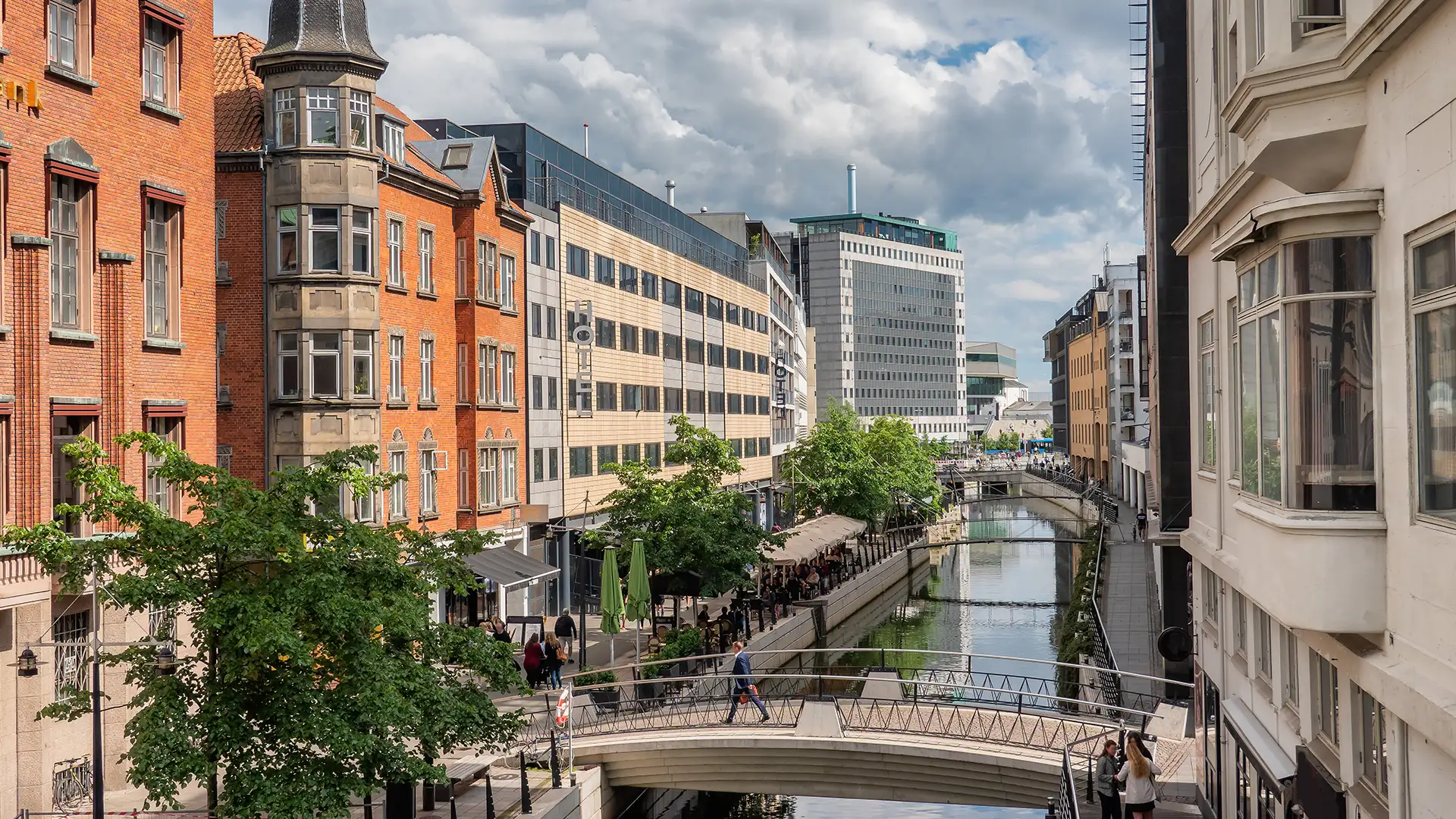
Aarhus Å curves through the city, creating reflections, narrow bridges and shadowed corners. At night the riverfront has a mixture of lively energy and subtle eeriness. A row of pubs and nightclubs trail the river promenade, and, sadly, accidents happen. Imagine a paranormal detective tracing a clue along the waterline or a spirit drifting under the surface.
The Latin Quarter
This is one of the oldest parts of Aarhus, with winding streets and cosy cafés. It appeared between the late 14th century, raised upon demolished Viking fortifications. The density and intimacy of the streets make them ideal for imaginative scenes.
ARoS Art Museum
ARoS is a modern landmark, famous for the Rainbow Panorama art installation; a circular walkway of coloured glass that transforms the city into a shifting prism. While not exactly urban fantasy, the Danish crime series “Dicte” frequently used the city’s landmarks as dramatic backdrops, including scenes filmed in and around the museum.
Den Gamle By
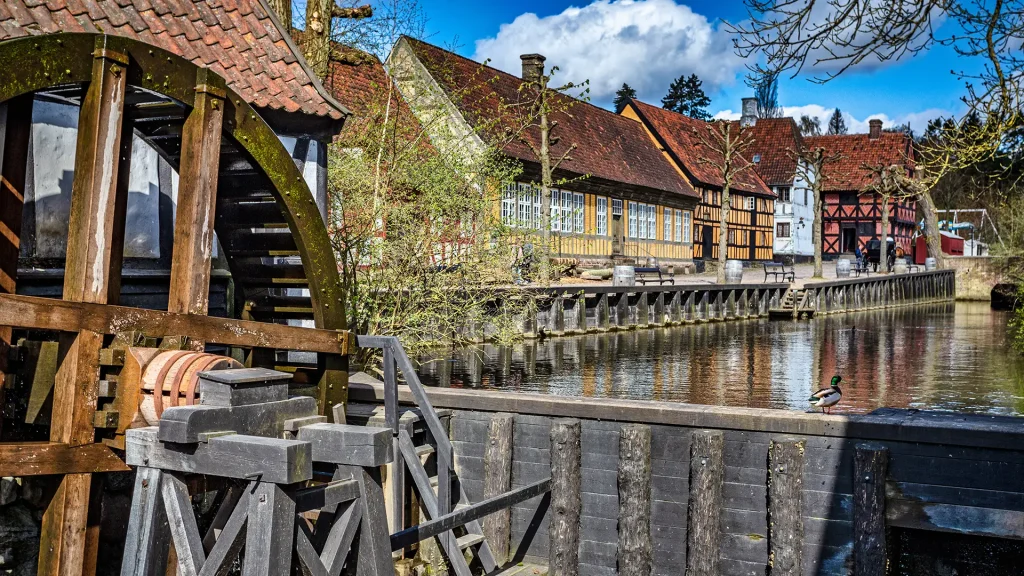
This open air museum recreates historical streets and interiors from different periods of Danish history. Here, time feels flexible. You could spend a day touring the 18th century, and could just imagine a portal opening here, or old spirits coming out of the woodwork.
Marselisborg Forests
A sprawling woodland at the city’s southern edge, filled with deer and long pathways. Forests have always held mythological significance in Scandinavia and have shaped centuries of folklore. The Ellefolk (Elf Folk) appears in stories as beautiful, dangerous, elusive beings that protect their own hidden domains. If they sound familiar to you, it is because in modern fantasy (and romantasy) they often resemble the capricious Fae. Writers of fantasy can easily picture something ancient moving between the trunks at dusk. But a fair warning from a Danish author with a vivid imagination: Inside quiet forests like Moesgaard, the boundary between our world… and other realms… feels thinner.
While the book is set in Iceland, in “Emily Wilde’s Encyclopaedia of Faeries” you’ll also get an interesting glimpse into faerie folklore, fae, and the fair folk.
Aarhus as a home for humorous urban fantasy
Humour thrives in contrast. Aarhus is a busy city with a Scandinavian mindset, which makes magical mishaps and supernatural surprises feel even funnier. An unemployed sleuth navigating the Danish unemployment bureaucracy to be eligible for benefits, hunting monsters during December drizzles, or chasing a possessed car in a high-intensity chase, until it suddenly senses an unmarked police vehicle and slows down to avoid a speeding ticket…
It happens in Career Ghouls and Christmas Spirits and albeit some of the circumstances will feel unfamiliar to foreign audiences, it allows for a different tone that can be used to full effect.
Aarhus and the shape of a supernatural mystery
By now you’ll probably have realised that I think Aarhus, and Denmark, has the perfect structure for supernatural whodunits and contemporary fantasy. Danish fantasy is thriving like never before, and other Danish authors have begun exploring other cities such as Copenhagen and Odense as backdrops for the fantastical. There possibilities are endless, and for cities with long histories, the sky’s the limit for plots concocted by vivid imagination.
Aarhus in the Clarke & Maine Mysteries
In my books, the city is an active presence that shapes the plot. From cursed job seminars to haunted villas in rich neighbourhoods, from the atmospheric streets in wintertime to future instalments taking place during summer. The characters can enjoy a mug of hot chocolate at a cosy café before taking a bicycle ride to an isolated lake near a dark forest, which is the great thing about urban fantasy mystery books set in Denmark. In my opinion, it can offer a fresh alternative to familiar tropes and settings. Yes, Chicago and New York certainly have appeal for fast-paced fiction, but Aarhus has old history and rustic charm going for it.
What’s remains for me is just to write more books.